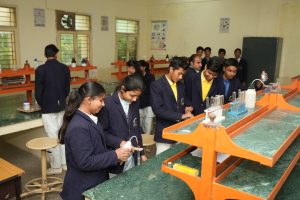
The school has well equipped Composite Science Lab. This laboratory is well equipped to conduct experiments as per the syllabi. The lab is periodically upgraded to fulfil the requirements of the curriculum. Students have facilities to perform experiments, to measure data and to analyse results so as to match their practical observations with theoretical knowledge.
Our composite laboratory in schools is a single, shared lab space used for multiple science subjects like physics, chemistry, and biology—especially common in middle and secondary schools. Its usefulness comes from both practical and educational advantages:
1. Better Use of Resources
Instead of maintaining separate labs for each subject, a composite lab saves space, equipment, and cost. Schools with limited infrastructure can still provide hands-on science learning without needing three different labs.
2. Encourages Practical Learning
Science becomes easier to understand when students perform experiments themselves. A composite lab allows students to:
- Observe real phenomena
- Test theories learned in class
- Develop curiosity and critical thinking
3. Interdisciplinary Understanding
Many scientific concepts overlap. For example:
- Studying plant cells (biology) may involve microscopes (physics)
- Chemical reactions connect to energy changes (chemistry + physics)
A composite lab supports this integrated approach to science.
4. Skill Development
Students learn important skills such as:
- Handling instruments safely
- Recording observations
- Analyzing results
- Working in teams
These are essential not just for science, but for overall problem-solving.
5. Inclusive for Smaller Schools
In rural or budget-limited schools, a composite lab ensures that all students still get lab exposure, even if resources are limited.
6. Flexibility in Teaching
Teachers can easily plan demonstrations or experiments without needing to shift between different lab rooms, making teaching more efficient.
composite lab makes science education practical, affordable, and accessible, which is especially important for developing a strong foundation in scientific thinking.